







The content of the article
- 1 What's inside?
- 2 birth defects
- 3 What utility?
- 4 Pros and cons
- 5 Let's wait a little?
Nowadays, more and more people talk about them - they say, here it is, bright future for the automotive industry! But is a certain “bright future” always necessary for us from a rational point of view??
Hybrid to hybrid strife - in their abilities they are so different, that even some classification of hybrid drives was born (parallel, sequential, etc.). We won't touch it, let's look at these cars from the consumer's point of view: what benefit does he get from, that his car has two types of engines - internal combustion engines and electric.
What's inside?
From the point of view of the power unit, that drives the car, hidden inside the hybrid are two cars - one with a conventional internal combustion engine, and the second with an electric motor, powered by battery. clear, that the car carries two sets of power drive on board for a reason, each one is used in this way, to replace the second one at the right time. Getting the best out of each drive, designers are trying to rid the car of shortcomings, inherent separately to internal combustion engines and electric traction.
For example, The internal combustion engine does not work perfectly at idle, when accelerating and decelerating the car: "eats" how much fuel in vain, pollutes the air, and for effective acceleration, everyone needs to try - and designers, and driver, and the car itself.
 Hybrids are different, but the most practical and economical in operation is the plug-in (Plug-in Hyubrid). It allows you to travel a short distance, using only electricity
In its turn, electronic traction does not have such a mode at all, like idle. After all, the electric motor immediately from a state of rest begins to rotate the box. And acceleration is his element: without preparatory promotion and gear changes, it gives its maximum torque from a standstill! Another positive quality of the electric motor is the energy recovery mode., when, when the car is coasting, the electric motor becomes a generator, which the, driven through the box from the wheels, charges the battery.
born vices
So why is it so wonderful, progressive electric drive does not drag the car without the help of others, why did he come up with an internal combustion engine as a partner? The trouble is in the battery, from which the electric motor is powered. thousand, usually it does not contain even half of the energy, which (in the form of gasoline) fits in the gas tank of the internal combustion engine. thousand, to fill it with energy (recharge) not necessary 2 minutes, but a few hours. B-3rd, battery is very expensive (up to a third of the price of the car). Finally, fourthly: battery ages pretty fast, and usually its replacement is simply unprofitable, since the cost of this procedure approaches the residual value of the entire machine. Not to mention the need to build the widest network of charging stations at every step.
READ ALSO Toyota introduced the Corolla hybrid station wagonYes, every year electric vehicles get more and more range, all charge their batteries faster and are all accompanied by a huge warranty period. Someday they will achieve the best performance of ICE cars in all respects., but automakers don't want to wait - they want to sell electric vehicles to us now. So they came up with hybrids.
It remains to state, that almost the main component of the hybrid is its module, responsible for the timely inclusion of a particular type of drive. That and the electric brain, and transmission unit.
What utility?
The practical benefit of hybrid cars is determined primarily by the capacity of the battery and partly by the method of charging it.. The simplest option is the so-called microhybrids, representing one of the complete sets of an ordinary model with an internal combustion engine. They have a small battery, which is recharged exclusively in the regenerative braking mode, descents from the mountain, etc.. The supply of electricity in it is only enough to support when starting from a place, and the case is limited to several starts, and again you need to wait for braking or descent from the mountain, to charge the battery.
 Due to the complexity of the design and additional components (electric motor, batteries, etc.) hybrid cars are more expensive than those with a classic internal combustion engine. To encourage the implementation of hybrids, marketers focus on their status
More common today are hybrids with larger batteries., which are recharged not only thanks to the recovery, but also specifically from the internal combustion engine. In many models, they not only support the gasoline engine to move off efficiently, but also give the opportunity to move for some time without it, i.e. electric power only.. It's good in traffic, in yards and parks, and in our conditions and when driving on broken roads, when you have to promote low speed, often slow down and speed up.
But the more practical of all hybrids is the so-called plug-in hybrid.. His battery, usually, large capacity, and it can be recharged from an external power source - a home outlet, charging in the parking lot, etc.. The energy reserve in the traction battery is enough for several 10 kilometers. With such consideration, so that the owner, recharged overnight in your own garage, could drive to work by electric traction every day. And for longer trips, use a gasoline engine., which connects as the battery "landing". This type of hybrid is most similar to an electric car., which has an internal combustion engine on board, if necessary, extending the mileage to "unlimited". Actually, the dominant role of the gasoline engine is characteristic of all cars, using a hybrid type of drive.
SEE ALSO How does automatic parking systemPros and cons
Focusing on own experience and on official data, you can compare the advantages and disadvantages of hybrid technology. Before all this - about the cons. So, a typical hybrid is not more economical than a car with an internal combustion engine. In certain modes and with a certain effort of the driver, savings are likely, but in general, many diesel cars consume less fuel, than hybrid classmates, while diesels are cheaper. A hybrid is generally significantly more expensive than a conventional car., because the client needs to pay extra for the traction battery, electric motor, extraordinary transmission and electronic control units.
For these reasons, a hybrid car is unlikely to ever be able to become mass and generally available.. Moreover, it is structurally much more difficult than a conventional machine., requires special maintenance and special training of mechanics. Not everything is clear from the standpoint of ecology. Disposal of the lithium-ion battery, which serves about 6-10 years, still remains an open question.
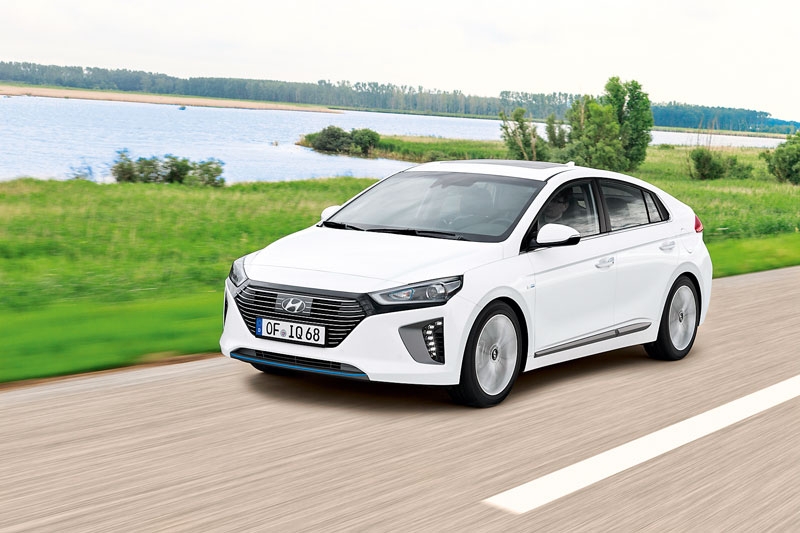
pros, however, also have, and for many they are significant factors when buying. So, hybrid car in certain conditions (eg, in the town) emits less exhaust gases. Specifically in urban conditions, the best dynamics are especially noticeable. And this is achieved without increasing the volume of internal combustion engines, adding turbocharging and excessive fuel consumption. Hybrid vehicles use electric drive when starting off, so their acceleration is very smooth, without jerks, but even expensive automatic machines with a torque converter in such cases have the ability to twitch unpleasantly, not to mention bots.
Let's wait a bit?
How we see, there are not so many real advantages in terms of practicality of hybrid cars. But enthusiastically note, that automakers continue to expand the range of hybrids in the range of their own products. At the same time, marketers came up with such a move: because due to the high cost of hybrids, it does not come out to position them as an economical transport for convenient citizens, then this technique is trying to give the charm of status. And it comes out! For many premium brands, it is these modifications that turn out to be the flagships in the catalogs.
